The Swedish Bus and Coach Federation (Sveriges Bussföretag) is the trade and employers' association for Sweden's bus and coach industry. It is one of the federations within the Swedish Confederation of Transport Enterprises (Transportföretagen), which is in turn part of the Confederation of Swedish Enterprise (Svenskt Näringsliv), Sweden's largest business organisation.
The federation represents companies engaged in all forms of professional bus and coach services – scheduled public transport, commercial bus services, and tourist and charter coach traffic – both within Sweden and across its borders. It was formed on 1 January 2014 through the merger of the National Association of the Swedish Bus Industry and the Bus and Coach Employers' Association, and today combines industry advocacy with employer and labour-market representation.
The Swedish bus and coach industry today
Sweden's bus and coach sector employs around 30,000 people nationwide. The federation itself has 227 member companies with a combined workforce of approximately 27,400 employees (2026), ranging from small, family-owned operators to large publicly owned companies. Municipally owned bus operators can join as partner companies, and around 50 sector stakeholders – vehicle manufacturers, IT companies, consultants and other suppliers – are also affiliated with the federation.
Buses and coaches carry out more than half of all public transport journeys in Sweden, and for roughly a third of the country's adult population, public transport is the only available travel option. About 90 percent of Swedish public transport is publicly procured.
The sector is also at the forefront of Sweden's transition to fossil-free road transport: over 85 percent of Swedish buses and coaches already run on renewable fuel, and the number of fully electric buses in traffic grew from 268 in 2019 to 1,453 in 2024.
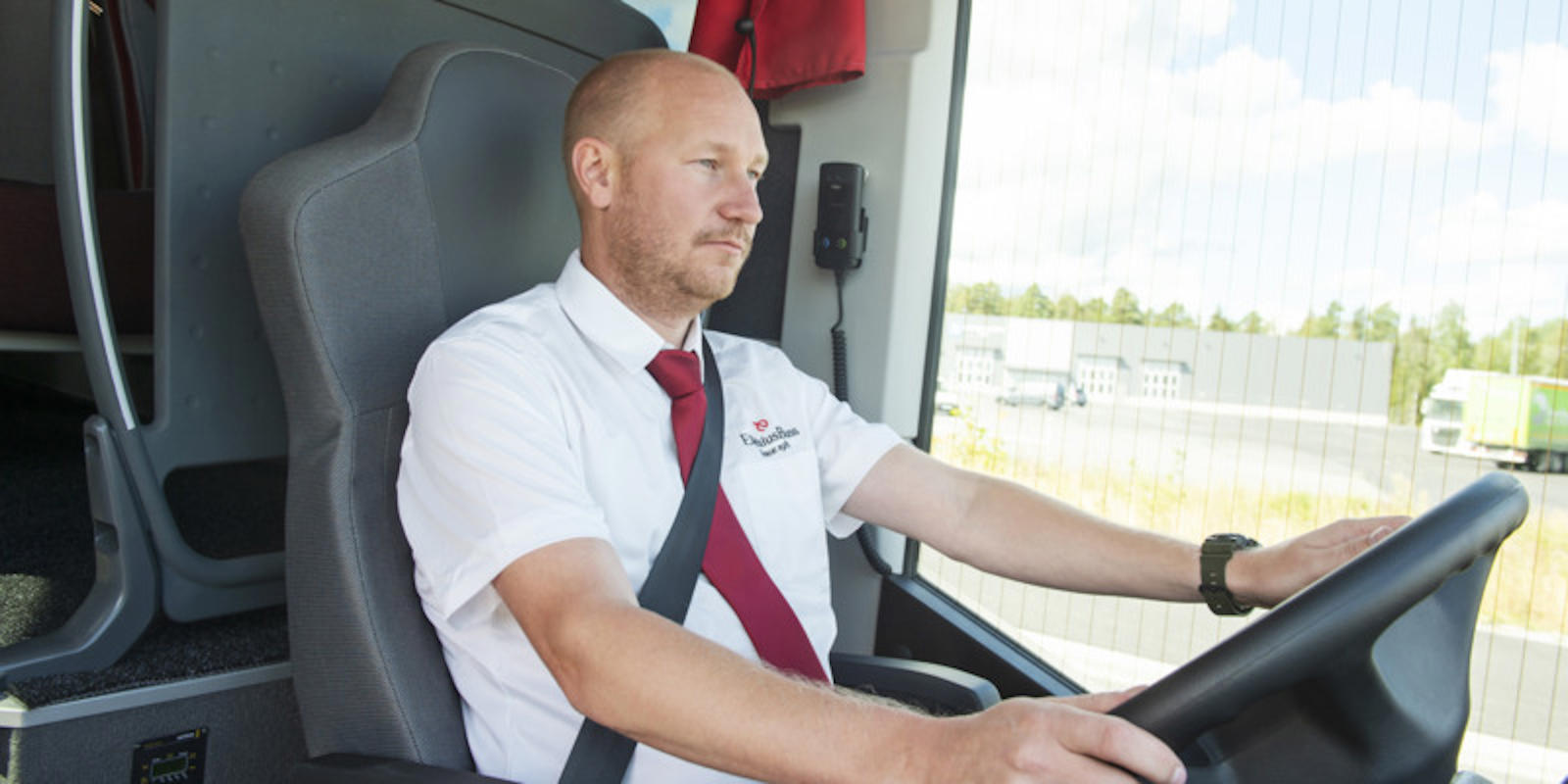
Like much of the transport industry, the sector faces a significant workforce challenge. An estimated 8,600 new bus drivers and mechanics will be needed over the next three years – about a third of today's drivers are 60 or older, while only 3 percent are under 30. Women currently make up 11 percent of bus drivers and 3 percent of bus mechanics. From October 2026, the entry-level monthly salary for a newly hired bus driver is SEK 30,810.
Traffic safety remains a core priority and a strong point for the industry: bus accidents in Sweden result in very few fatalities – one in 2024 and one (preliminary) in 2025, according to the Swedish Transport Agency.
Structure and governance
The federation is governed by a General Assembly and a Board, supported by a Nomination Committee, a Sectorial and Industry Committee, an Employer Committee, and five Regional Committees covering North, Central, East, West and South Sweden. Member companies are also organised in five regional bus and coach associations.
The Board is chaired by Martin Pagrotsky, Nobina. The head office team is led by Jonas Hagelqvist, CEO of the Swedish Bus and Coach Federation and the Swedish Confederation of Transport Enterprises, and Anna Grönlund, Deputy Managing Director and Head of Industry and Advocacy.
Together with the Confederation of Swedish Enterprise, the federation has local offices in Falun, Gothenburg, Jönköping, Malmö, Stockholm, Umeå and Växjö.
International engagement
The Swedish Bus and Coach Federation is active in several international bodies that shape the regulatory and policy environment for bus and coach transport in Europe:
- IRU (International Road Transport Union): the federation's Head of Industry and Advocacy is President of IRU's passenger transport section.
- UITP (International Association of Public Transport): together with the Swedish Public Transport Association (Svensk Kollektivtrafik), the federation makes up Sweden's delegation to the UITP EU Committee.
- Partnership for Improved Public Transport (Partnersamverkan för en förbättrad kollektivtrafik): a collaboration platform for Swedish public transport authorities, operators and the Swedish Transport Administration.
Current priority issues (2026)
- Attracting more people to become bus and coach drivers – including implementing the EU minimum age for professional bus driving, removing the 50 km distance limit for drivers under 24, and introducing state-backed (CSN) student loans for a D-licence.
- Supporting the national public transport goal that, by 2030, four out of ten motorised journeys in Sweden should be made by public transport – a key issue ahead of Sweden's 2026 general election.
- Encouraging more Public Transport Authorities to follow the recommendations of the Public Transport Procurement Committee (Kollektivtrafikens Avtalskommitté).
- Ensuring environmental zones do not become an obstacle to bus and coach operations, and increasing seatbelt use on buses.
- Improving infrastructure and traffic flow for buses, including Bus Rapid Transit (BRT) systems, and increasing the share of regional transport in the National Transport Plan.
- Reforming the travel guarantee system and vehicle tax rules for temporarily decommissioned vehicles.
Membership
Membership in the Swedish Bus and Coach Federation gives bus and coach companies access to expert support across labour law, negotiations, work environment issues and industry-specific regulatory guidance. Membership includes:
- Free advice in labour law and collective agreement matters from experienced labour law lawyers and negotiators.
- Cost-effective pension and insurance solutions.
- Negotiation assistance from negotiators and labour law lawyers.
- Help with interpretation of collective agreements.
- Assistance in district court and labour court in disputes concerning the relationship between employer and employee.
- Counselling on work environment issues.
- Access to the "Arbetsgivarguiden".
- A wide range of courses in practical labour law, work environment, negotiation techniques and salary administration.
- Updated information about changes in labour law and work environment law via the website, newsletters and company visits.
- Advice on driving and rest periods.
- Member discount on authorisation checks for commercial traffic (BKY).
- Monitoring of the bus industry's interests at government and EU level, including business conditions, bus measurements and specifications, establishment criteria and professional competence requirements.
- The weekly digital newsletter Buss-info.
- Access to the industry's collective knowledge on laws and regulations for professional traffic, procurement principles for regular traffic, school transport and other services, environmental issues, statistics, technology, and international and tourist traffic.
- Membership in the federation's regional departments, which carry out advocacy work and activities in each region.
- Discounted prices for legal advice in business law and public procurement, and other services related to law, contracts and business processes.
- Help with VAT recovery abroad through partners.
- Access to general terms and conditions for package tours.
- Access to the federation's database "Bus regulations country by country", covering documents, tolls, VAT, minimum wages, environmental zones and more for driving a bus across Europe.